Case study 05 · Serverless product delivery
Automate the customer journey, not just the feature.
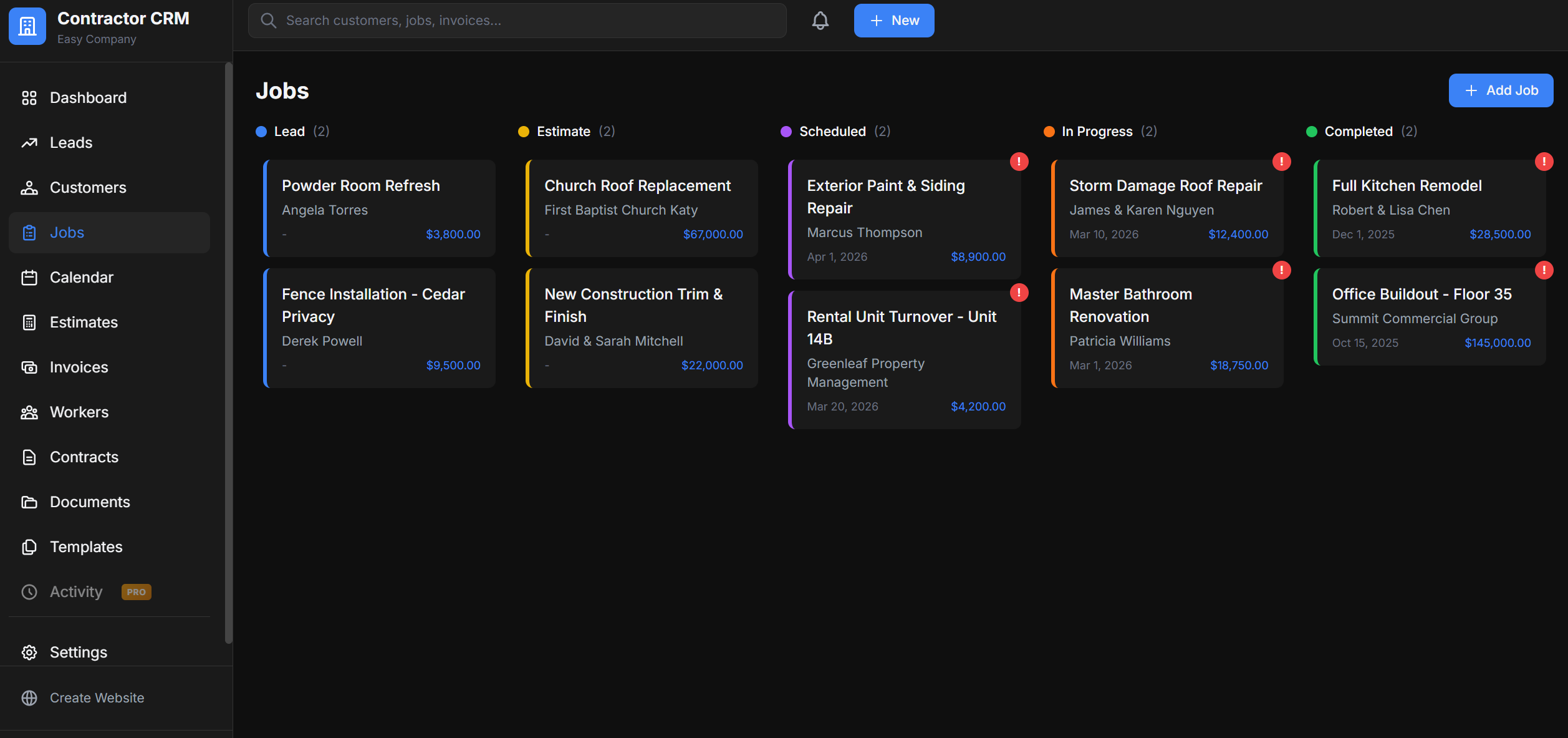
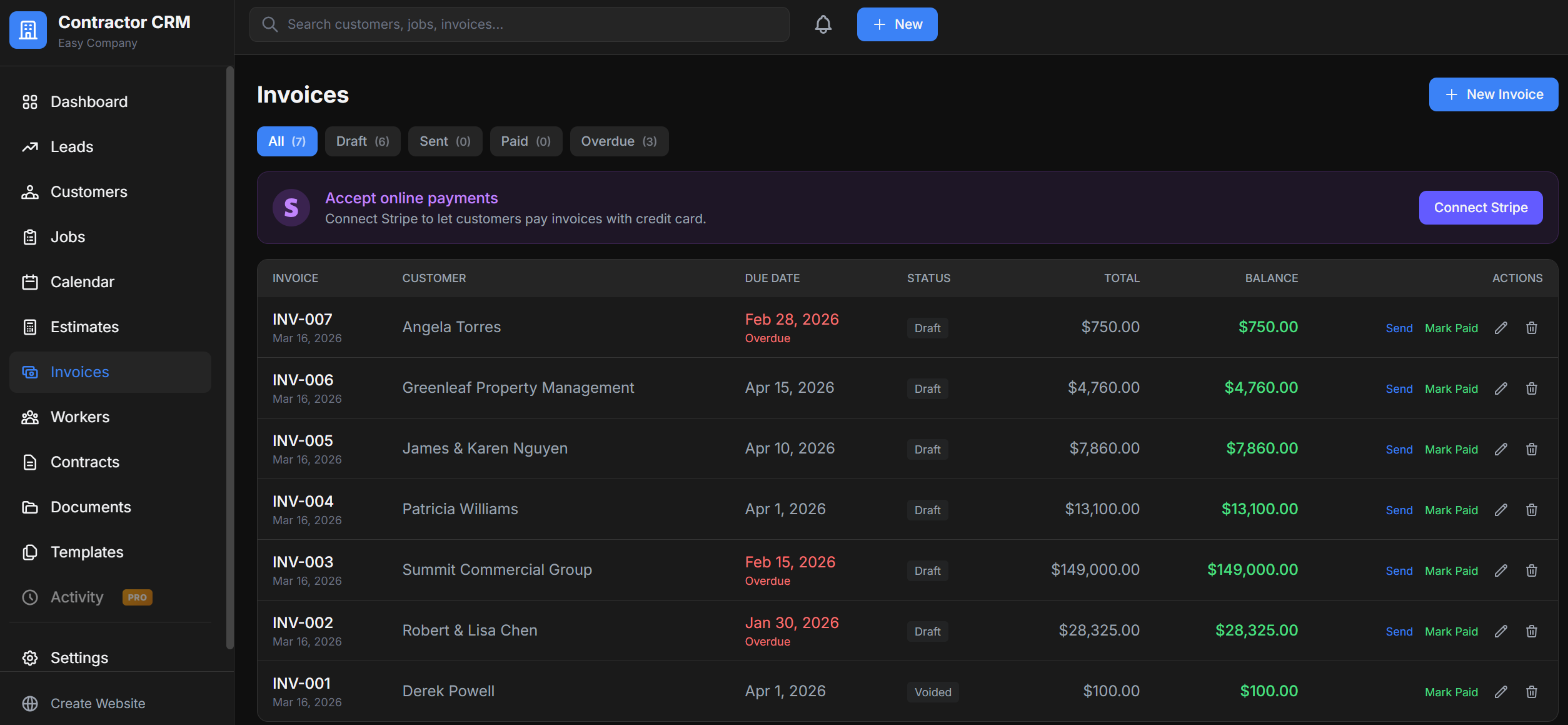
Contractor CRM turns a business event into a provisioned, secure, usable experience without making the customer understand the infrastructure: customer records, jobs, estimates, invoices, scheduling, and a web presence for service contractors.
- Role
- Product architect, full-stack and cloud builder
- Users
- Small service contractors and their teams
- Stack
- AWS Lambda, API Gateway, DynamoDB, S3, Cognito, Stripe
- Boundary
- Architected and built; shown as screenshots, not a public route
The problem
Small customers cannot carry enterprise implementation overhead.
A useful small-business product has to compress setup, data entry, infrastructure, and operating complexity into a flow the customer can complete without a technical team.
For contractors, that means moving from customer and job activity into scheduling, estimates, invoices, and a web presence. The engineering challenge is an end-to-end one: identity, tenant boundaries, event handling, payment state, generated assets, hosting, and support behavior must agree on the same customer lifecycle.
Architecture
From customer event to provisioned experience.
Scale-to-zero services keep the operating shape small while preserving explicit boundaries between identity, workflow, data, and delivery.
- 01 / Event
Customer action
Account, checkout, booking, job, estimate, or invoice event.
- 02 / API
Workflow entry
API Gateway and Lambda validate identity, tenant, request, and product state.
- 03 / Data
Durable customer state
DynamoDB records, S3 assets, and Cognito identity remain separated by customer context.
- 04 / Automation
Provisioning and notifications
Billing state, notifications, generated assets, and infrastructure actions.
- 05 / Experience
Hosted result
Customer dashboard, business workflow, and generated web presence.
Design principle
The customer should experience one product, even when the workflow crosses ten services.
What this demonstrates
- Serverless architecture and event-driven workflows
- Multi-tenant identity and data boundaries
- Stripe-triggered product state
- Hosted-site provisioning and object storage
- Environment separation and operational safeguards
Outcome
Built end to end, honest maturity.
The codebase demonstrates a complete serverless product journey rather than an isolated feature. The strongest evidence is the integration work: customer identity, data, payment, generated content, hosting, and ongoing use all meet in the same flow.
It also preserves an engineering lesson: infrastructure existing in a repository is not the same as every production path using it. Environment separation, deployment automation, and customer boundaries must be verified at each function and workflow, not inferred from a design document.